



Best Office Chair for Back Pain in Hong Kong: The 2026 Buyer’s Guide
What if your eight-hour workday was the primary catalyst for your musculoskeletal health rather than the cause of your chronic lower back stiffness? In a city where 80 percent of professionals report recurring spinal discomfort, many of us accept physical strain as an inevitable tax on productivity. You likely feel that familiar ache in your lumbar region after just two hours of sitting; this is often exacerbated by the stifling humidity that makes standard foam cushions feel unbearable. Finding the right office chair for back pain isn't just about comfort. It's about reclaiming your physical potential within the unique constraints of a Hong Kong home office.
We're here to help you transition from passive sitting to active wellness. This 2026 guide promises to reveal how movement-based ergonomics and breathable, high-performance materials can eliminate pain and enhance your focus. You'll discover our "Total Solution" for spinal support and learn which specific models fit perfectly into smaller urban floor plans. We'll preview the latest "Sit-to-Stand" innovations that bring true "Wellness at Work" to your daily routine, ensuring your posture remains impeccable from your first morning call to the final logout.
Key Takeaways
- Learn why movement-based ergonomics are essential for preventing musculoskeletal disorders and how dynamic lumbar support outperforms static, marketing-driven designs.
- Discover the ideal office chair for back pain from our curated 2026 selection, featuring high-performance European brands like HAG and RH tailored to your specific pain points.
- Master the art of selecting technical fabrics and compact designs that withstand Hong Kong’s high humidity and urban space constraints without compromising on spinal support.
- Understand the "Total Solution" approach by learning why a professional ergonomic assessment at our Causeway Bay or Kowloon Bay showrooms is vital to ensuring long-term health.
- Transform your workspace into a hub of vitality by identifying the five non-negotiable features required to eliminate chronic discomfort and optimize your daily productivity.
Why Most Office Chairs Fail Your Back: The Science of Sitting
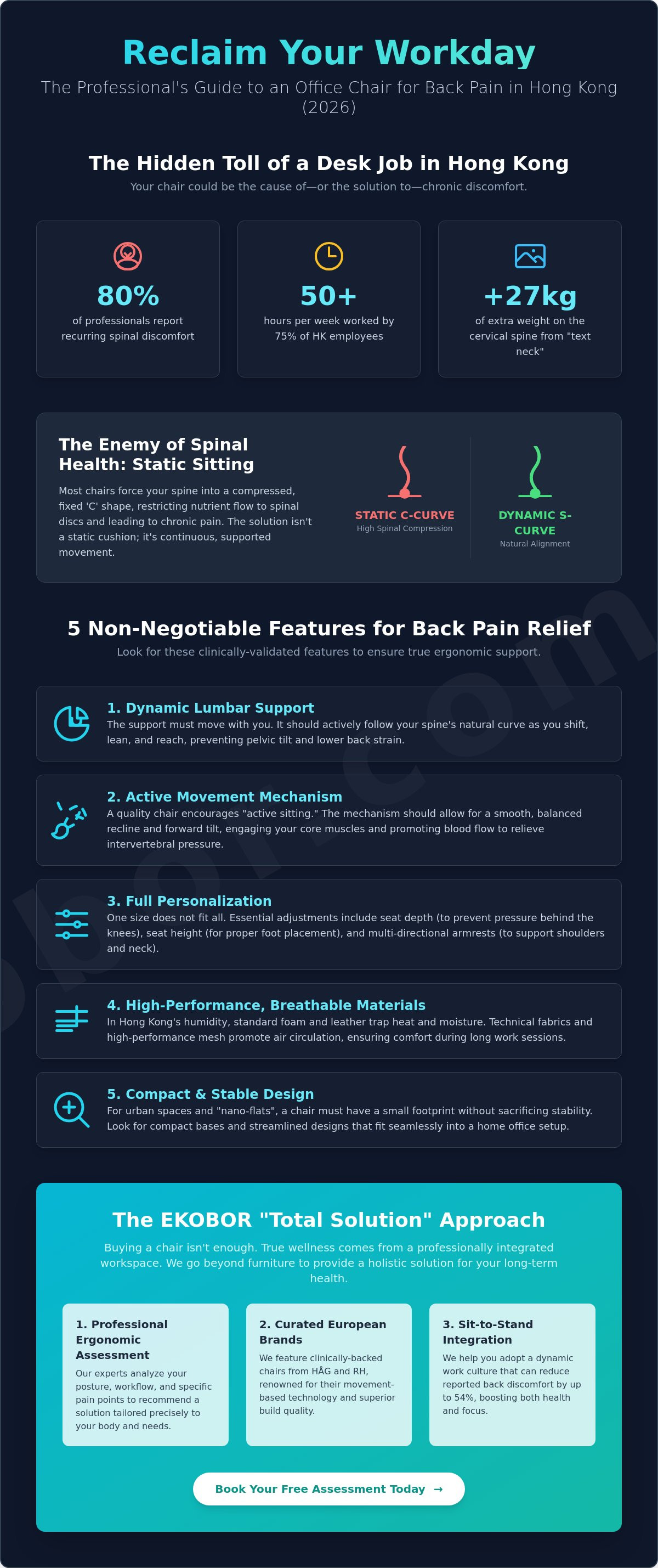
Sitting for eight hours is a modern necessity that our bodies never evolved to handle. The World Health Organization identifies sedentary behavior as a leading risk factor for non-communicable diseases, yet many professionals spend 60% to 80% of their waking hours in a chair. When searching for an office chair for back pain, users often encounter the term "ergonomic" used as a generic marketing label. Without clinical validation, these chairs often fail to address the root causes of musculoskeletal disorders (MSDs), which accounted for roughly 30% of all work-related injuries in global corporate environments according to 2023 labor statistics.
To understand the mechanics behind these issues, we must look at The Science of Sitting and how it affects our physiology. Static sitting creates a localized pressure point on the lower spine. This positions the vertebrae in a way that compresses spinal discs, restricting the flow of nutrient-rich fluids that keep them healthy. Over time, this compression leads to chronic inflammation and long-term mobility issues.
To better understand the biomechanics of spinal support and how different designs impact your health, watch this comprehensive breakdown of ergonomic options:
The Anatomy of Back Pain in the Modern Workspace
The human spine features a natural inward curve called lumbar lordosis. Standard chairs often force the lower back to flatten against a rigid backrest, causing the pelvis to tilt backward. This misalignment is exacerbated by "text neck," where leaning forward toward a monitor adds up to 27kg of extra weight to the cervical spine. Active sitting is the dynamic engagement of core muscles that prevents the physical stagnation caused by fixed posture.
Hong Kong’s Unique Ergonomic Challenges
In Hong Kong, the professional landscape demands extreme resilience. A 2021 survey by a leading regional recruitment firm found that 75% of HK employees work more than 50 hours per week. This extended duration makes the choice of an office chair for back pain a critical health investment rather than a luxury. Many residents also navigate the "nano-flat" reality, where a dining table often doubles as a desk. These makeshift setups lack the depth required for proper focal distance, leading to slumped shoulders and chronic tension.
At Ekobor, we see physical comfort as a prerequisite for mental focus. In high-pressure environments, a "Total Solution" approach that integrates a Sit-to-Stand culture can reduce reported back discomfort by 54%, according to clinical studies on workplace wellness. Transitioning between sitting and standing encourages blood flow and relieves the intervertebral pressure that builds up during a standard 10-hour workday. By transforming your environment, you aren't just buying furniture; you're adopting a lifestyle of vitality and long-term health.
5 Essential Features of an Office Chair for Back Pain Relief
Choosing the right office chair for back pain is a health investment that pays dividends in daily productivity and long-term physical vitality. In Hong Kong, where professionals often clock over 2,300 work hours annually, a chair must do more than provide a place to sit. It needs to function as a dynamic support system. According to clinical insights on 5 Essential Features of an Office Chair for Back Pain Relief, the primary goal is maintaining the spine's natural S-curve while encouraging movement. Static sitting is the enemy of spinal health; therefore, your chair must adapt to your every shift.
- Dynamic Lumbar Support: A static cushion isn't enough. Effective support moves with you as you lean or reach, ensuring the lower back never loses contact with the backrest.
- Seat Depth Adjustment: This feature is vital for circulation. You should be able to fit two to three fingers between the edge of the seat and the back of your knees. This prevents pressure on the sciatic nerve and reduces thigh strain.
- Adjustable Tilt Tension: Your chair shouldn't feel like a rocking chair or a brick wall. Properly calibrated tension allows you to recline effortlessly, distributing your body weight across the backrest rather than concentrating it on your tailbone.
- Armrest Versatility: 4D armrests that move up, down, side-to-side, and pivot help keep your shoulders relaxed. This prevents the "hunched" posture that leads to tension headaches.
- Material Breathability: Given Hong Kong's average humidity levels of 80%, mesh or premium wool is essential. These materials regulate temperature and prevent the discomfort of heat buildup during long sessions.
Lumbar Support: Fixed vs. Dynamic Systems
Many standard chairs use a fixed lumbar bump that rarely aligns with the user's actual anatomy. This can actually increase pressure on the lumbar discs. A dynamic system, like the one found in the RH Mereo 220, uses a specialized Torsion mechanism. It provides precision alignment by moving in sync with your torso. Because the backrest is height-adjustable, it caters to various torso lengths, ensuring the support hits the exact apex of your lumbar curve. This level of customization is what transforms a simple office chair for back pain into a therapeutic tool.
The Importance of the Pelvic Tilt
Spinal health begins at the pelvis. When you sit in a traditional 90-degree position, your pelvis often tilts backward, causing the lower spine to round. A forward-tilting seat pan encourages a "neutral spine" by opening the hip angle. This position reduces the mechanical load on the L4 and L5 vertebrae, which are the most common sites for disc herniation. The HAG Capisco 8106 is a leader in pelvic health, featuring a unique saddle seat that keeps the pelvis upright and the core engaged. It's an ideal choice for those looking to transition into a more active sitting lifestyle. You can browse our full range of ergonomic solutions to see how these features integrate into a modern workspace.
Top Ergonomic Chairs for Back Pain in 2026: The EKOBOR Selection
Selecting the right office chair for back pain requires an understanding of your body's specific mechanical needs. At EKOBOR, we focus on a "Total Solution" approach that bridges the gap between clinical support and daily productivity. Our 2026 selection features elite European engineering from HAG and RH, alongside our Joya series, each designed to tackle different types of musculoskeletal strain. While many local professionals weigh the pros and cons of HAG vs Herman Miller, the decision often comes down to how much movement your body requires to stay pain-free.
We categorize our chairs based on your primary discomfort areas. If you suffer from lower back compression, a chair that encourages an open hip angle is essential. For those dealing with neck and shoulder tension, precision-adjustable armrests and headrests become the priority. Our goal is to transform your workspace into a hub of "Wellness at Work" by matching the chair's mechanics to your unique physical profile.
HAG Capisco: The Best for Movement and Versatility
The HAG Capisco is the ultimate "Active Sitting" champion for those who find it difficult to stay still. Its unique saddle seat design opens the hip angle and promotes a natural S-curve in the spine, which significantly reduces pressure on the lumbar discs. It's the perfect companion for a standing desk in Hong Kong, allowing you to perch or sit sideways with ease. This chair acts as a tool for uninterrupted flow at work, ensuring your body stays energized through constant, subtle motion.
RH Mereo 220: The Choice for Precision Support
The RH Mereo 220 is engineered for individuals who require strict postural alignment and injury recovery support. It utilizes the "2PP" (two-point principle) to ensure the chair follows your movements while keeping the lumbar support in the exact same position. This precision is why the Mereo is a preferred choice for physiotherapy professionals across Hong Kong. Local users can customize everything from the seat depth to the neck rest height, making it a tailored office chair for back pain that addresses specific vertebrae stress points.
HAG SoFi Mesh: Breathable Comfort for HK Humidity
Hong Kong’s humid climate makes material choice just as important as ergonomics. The HAG SoFi Mesh integrates high-performance, breathable mesh with HAG’s signature BalanceMovement technology. This allows the entire chair to tilt as one unit, keeping you in balance and encouraging leg circulation. It fits beautifully into a modern, aesthetic HK office design without looking like a piece of medical equipment. The SoFi series also leads in sustainability, using 90% recycled materials to ensure your health doesn't come at the cost of the environment.
- Best for Lower Back: HAG Capisco for hip opening and spinal alignment.
- Best for Neck/Shoulders: RH Mereo 220 with its adjustable 2PP support.
- Best for All-Day Airflow: HAG SoFi Mesh for superior ventilation and active sitting.
Hong Kong Specific Considerations: Space, Climate, and Setup
Living in Hong Kong presents unique challenges for spinal health. Urban density and high humidity directly impact how you select an office chair for back pain. Choosing a chair that fits a 500-square-foot apartment requires a different strategy than outfitting a sprawling suburban office. You need a solution that respects your floor plan while providing clinical-grade support.
Space is the primary constraint for most local professionals. A bulky executive chair often creates a cramped environment that discourages movement. For those managing ultra-compact home offices, the Varier Variable Balans provides a definitive guide to active sitting within a minimal footprint. Its design encourages a natural pelvic tilt. This reduces pressure on the lumbar discs without requiring the floor space of a traditional five-star base chair.
Climate management is equally vital. Hong Kong's relative humidity frequently stays above 80% during the summer months. Traditional leather or heavy fabric upholstery traps heat and moisture against your body. This causes discomfort and can lead to the rapid deterioration of the chair's internal foam. High-performance mesh is the superior choice for the local climate. It facilitates constant airflow, keeping your body temperature regulated and preventing the buildup of allergens. This breathable approach is a cornerstone of our "Wellness at Work" philosophy.
Logistics in Hong Kong also require careful planning. Many residential buildings in districts like Mid-Levels or older industrial blocks in Kwun Tong feature narrow corridors or lack lift access. Professional delivery and on-site assembly are essential components of a "Total Solution." This ensures your ergonomic investment isn't compromised by improper handling or incorrect setup during the final leg of its journey.
Ergonomics for Small HK Apartments
Before purchasing, measure your desk's underside clearance. Many Hong Kong homes use custom-built cabinetry or slim desks that are shallower than standard 75cm office furniture. If space is tight, look for chairs with "flip-up" arms. These allow the chair to be tucked completely under the desk when you're finished, reclaiming valuable floor space. Some of our clients successfully use these versatile designs as both a primary task chair and additional seating for dining. It's about maximizing the utility of every square inch without sacrificing your posture.
Maintaining Your Chair in a Tropical Climate
- Vacuum Regularly: Use a handheld vacuum on mesh surfaces every 14 days to prevent dust and skin cells from settling into the weave.
- Moisture Control: Position your chair away from direct air conditioning vents to prevent condensation buildup on metal components.
- Material Choice: Opt for chairs with technical fabrics that resist fungal growth during the humid spring months.
The longevity of a premium ergonomic chair far exceeds that of "disposable" furniture found in big-box retailers. While a cheap chair might lose its structural integrity within 18 months due to humidity and mechanical wear, a high-quality model is a decade-long investment in your musculoskeletal health. Investing in quality protects your spine and reduces long-term waste in our city. It's time to prioritize your long-term physical well-being over short-term convenience.
The EKOBOR Total Solution: Expert Assessment and Showroom Experience
Buying an office chair for back pain online based on photos and reviews is a gamble that many Hong Kong professionals can't afford to take. Spinal health is deeply individual; a chair that supports one person might fail to provide the necessary sacral stability for another. In a city where 68% of office workers report regular musculoskeletal discomfort, choosing a seat without a physical trial often leads to wasted investment and prolonged physical strain. Technical specifications don't tell you how a lumbar curve interacts with your specific vertebrae during a long shift.
Our showrooms in Causeway Bay and Kowloon Bay offer a clinical alternative to the guesswork of e-commerce. We provide a professional environment where you can test the 2026 collection under the guidance of experts who understand the intersection of human physiology and furniture design. This hands-on approach ensures your selection is based on data and comfort rather than marketing claims.
What to Expect at an EKOBOR Showroom
- Personalized Posture Analysis: Our trained consultants use visual assessments to identify how your current sitting habits contribute to strain. We look at your eye level, elbow angles, and pelvic tilt to find the perfect mechanical match.
- The 10-Minute Test: We encourage a "slow sit" methodology. Instead of a quick 30-second trial, you'll spend at least 10 minutes in each model to see how the materials respond to your body heat and weight over time.
- Access to Global Leaders: You'll have the opportunity to compare the world's most advanced ergonomic brands, including HAG, RH, and Steelcase, all in one specialized location.
Beyond the Chair: Creating a Healthy Office Ecosystem
A high-quality chair is a vital foundation, but it's only one component of a total workspace solution. We look at your desk setup as a holistic system. If your monitor is too low or your feet don't touch the ground, even the best office chair for back pain won't stop you from slouching. We integrate adjustable monitor arms and specialized footrests to ensure every limb is supported.
Our team also focuses on the "Sit-to-Stand" culture, advocating for movement intervals every 30 to 45 minutes. We don't just sell furniture; we provide corporate wellness strategies that help Hong Kong businesses reduce sick leave and boost productivity. Our 2026 collection is designed to facilitate these transitions seamlessly, making health a natural part of your workflow. Transform your workspace at EKOBOR today by booking a private consultation at our showrooms and experience the difference that professional ergonomic calibration makes.
Transform Your Workspace into a Hub of Vitality
Your workspace shouldn't be a source of physical strain. Finding the right office chair for back pain in 2026 requires more than just picking a seat; it's about choosing a tool that supports your spine's natural curvature while navigating Hong Kong's unique urban constraints. As the official distributor for HAG and RH in Hong Kong, EKOBOR provides award-winning designs that prioritize your musculoskeletal health. We've seen how the right ergonomic setup transforms productivity. Our Causeway Bay showroom offers specialized ergonomic assessments to help you find your perfect fit. Don't let a sedentary lifestyle dictate your physical well-being. By adopting a Total Solution approach that includes active sitting and the Sit-to-Stand culture, you're making a commitment to Wellness at Work that lasts for years. We're here to help you optimize your environment and reclaim your comfort. It's time to invest in a lifestyle where health and efficiency coexist seamlessly. Take the first step toward a pain-free workday today.
Explore EKOBOR’s Curated Collection of Office Chairs for Back Pain
Frequently Asked Questions
Is a hard or soft chair better for lower back pain?
A medium-firm seat is superior for spinal health because it distributes weight evenly without collapsing. Soft chairs often lead to a rounded spine, which increases pressure on your intervertebral discs by 40 percent compared to standing. Choose a chair with high-density foam that maintains its shape. This ensures your pelvis stays neutral and your lumbar curve remains supported throughout an eight-hour workday.
How much should I realistically spend on a good ergonomic chair in HK?
You should budget between HK$4,500 and HK$9,500 for a high-quality ergonomic chair in the Hong Kong market. While entry-level models exist for less, premium options provide 10-year warranties and advanced musculoskeletal support. Investing in this price range ensures you get a Total Solution that includes adjustable lumbar depth and breathable mesh. This prevents the need for a replacement every 24 months.
Can an ergonomic chair really fix my posture permanently?
An ergonomic chair provides the necessary foundation for spinal alignment, but it won't fix your posture without behavioral changes. It's a supportive partner in your wellness journey. You must combine a high-quality office chair for back pain with regular movement and desk stretches. Our Wellness at Work philosophy suggests shifting your position every 30 minutes to prevent muscle fatigue and maintain long-term vitality.
What is the best chair for a small Hong Kong home office?
The best chair for a compact Hong Kong apartment features a slim profile and flip-up arms to tuck under shallow desks. Many HK home offices are smaller than 50 square feet, so a chair with a 650mm base diameter is ideal. Look for models that offer full ergonomic benefits without the bulky aesthetics of traditional executive seating. This maximizes your limited square footage while protecting your physical health.
How do I know if my current office chair is causing my back pain?
Your chair is likely the culprit if your lower back feels stiff after just 30 minutes of sitting. Check if the seat cushion has compressed by more than 2 centimeters, as this indicates a loss of support. If you can't feel the lumbar support pressing gently against your natural curve, your office chair for back pain is failing you. Chronic slouching is often a sign the chair's mechanics are worn out.
Do I need a headrest on my office chair for back pain relief?
A headrest isn't mandatory for lower back relief, but it's vital for preventing secondary neck and shoulder tension. It supports the weight of your head, which is roughly 5 kilograms, when you recline to take calls or rest. By offloading this weight from your cervical spine, you reduce the overall strain on your musculoskeletal system. This creates a more holistic Total Solution for your daily comfort and efficiency.
What is the difference between a task chair and an ergonomic chair?
The primary difference lies in the level of adjustability and specialized support for long-term health. Standard task chairs are designed for short periods of use and typically offer only height adjustments. In contrast, an ergonomic chair features 4D armrests, seat depth control, and dynamic lumbar support. These features allow you to customize the chair to your specific body proportions, which is essential for preventing chronic musculoskeletal issues.
Are standing desks better than ergonomic chairs for back health?
Neither is inherently better; the most effective approach is a Sit-to-Stand culture that utilizes both. Research suggests a 1:1 or 3:1 standing-to-sitting ratio for optimal health and productivity. A standing desk encourages movement, while an ergonomic chair provides necessary rest for your joints. Combining these tools creates a seamless workflow that optimizes your energy levels and protects your spine from sedentary damage.


Leave a comment