



Standing vs Sitting Desk: The Definitive Health and Productivity Comparison for 2026
Did you know that switching your posture for just 60 minutes a day could reduce your chronic back pain by 54%? For many professionals navigating the dense business hubs of Central or Kowloon, the typical 10 hour workday is a grueling marathon of sedentary confinement. It's a cycle that often leads to a throbbing lower back by 4:00 PM and a persistent concern over long-term risks like type 2 diabetes. When evaluating a standing vs sitting desk, the choice isn't just about furniture; it's about reclaiming your physical vitality in a high-pressure environment.
You likely already feel the toll that "sitting disease" takes on your focus, especially during that dreaded post-lunch energy slump. At EKOBOR, we believe in a Total Solution that bridges the gap between clinical necessity and aesthetic appeal. This guide promises to reveal the science-backed truth about workplace ergonomics and provide a clear roadmap for your transition. You'll learn how to master a sustainable sit-to-stand routine that protects your musculoskeletal health and enhances your "Wellness at Work" through 2026 and beyond.
Key Takeaways
- Understand why the standing vs sitting desk debate is crucial for Hong Kong professionals and how to balance physical fatigue with long-term musculoskeletal health.
- Deconstruct the "sitting is the new smoking" myth to realize why static standing is equally harmful and how consistent movement is the true clinical cure.
- Master the science-backed "20:8:2 Rule" to find your optimal sit-to-stand ratio, significantly reducing intradiscal pressure while boosting metabolic health.
- Learn to implement a "Total Solution" that combines premium ergonomic seating with the I-Standing Electric Standing Desk for a seamless wellness transformation.
- Follow a step-by-step transition guide designed to shift you from a 100% sedentary routine to a dynamic, high-performance workspace.
The Great Debate: Standing vs. Sitting Desk Dynamics in 2026
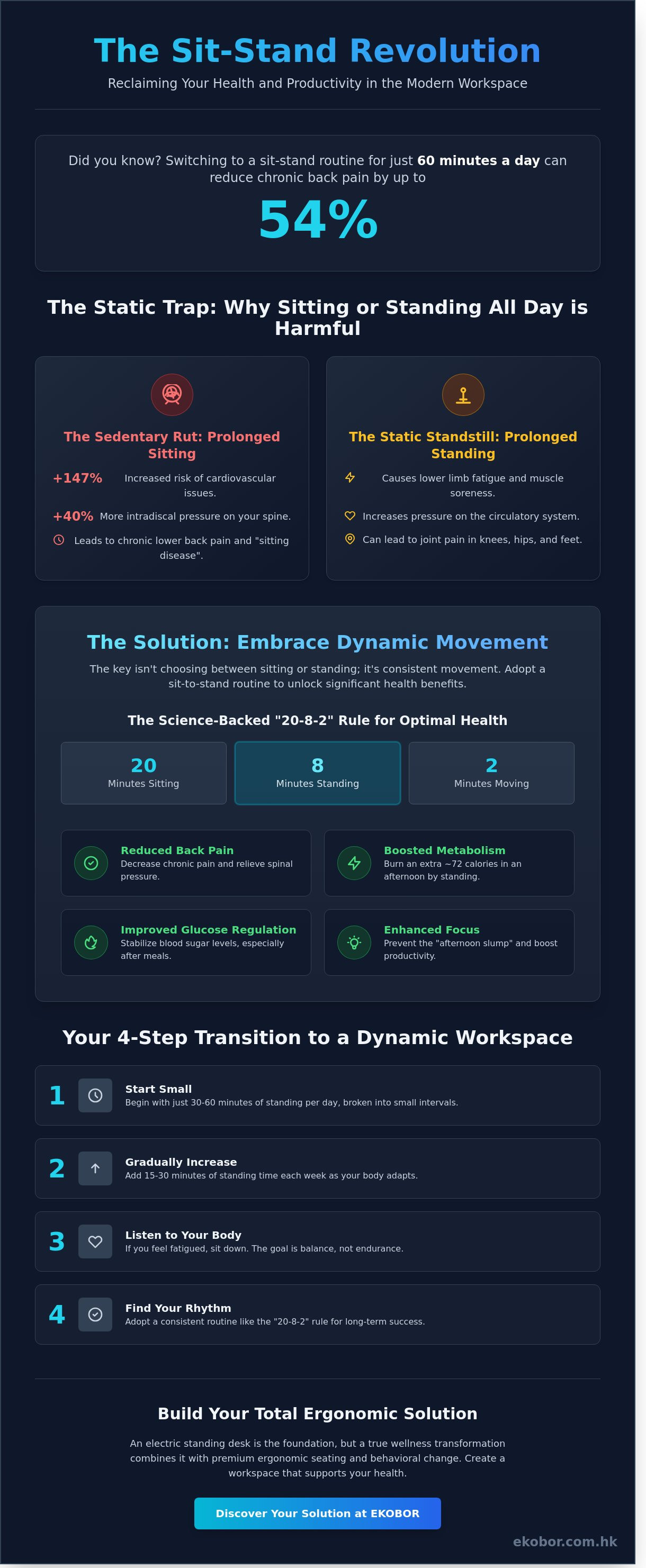
The debate regarding a standing vs sitting desk isn't a new one, but in 2026, it has reached a critical turning point for professionals in Hong Kong. We've spent decades hearing about the dangers of "sitting disease," which increases the risk of cardiovascular issues by 147 percent according to longitudinal health studies. However, the alternative of static standing brings its own set of challenges, including lower limb fatigue and increased pressure on the circulatory system. Neither position is a magic bullet for health when maintained for hours on end.
In the dense corporate landscape of Hong Kong, where professionals in districts like Central or Quarry Bay often clock over 50 hours per week, the choice between positions becomes a matter of long-term musculoskeletal health. The solution isn't to pick a side; it's to embrace a "Sit-to-Stand" culture that prioritizes active movement over static posture. Our bodies are designed to move, and the modern workspace must reflect this biological necessity to prevent chronic pain and fatigue.
To better understand this concept, watch this helpful video:
The Evolution of the Hong Kong Workspace
Hong Kong office design has undergone a radical transformation since the 2024 workplace wellness census. We've moved away from rigid, traditional cubicles toward wellness-focused ergonomic hubs that treat the office as a tool for vitality. This shift is particularly evident in the rise of hybrid work, where limited square footage in HK nano-flats has forced a demand for compact, high-efficiency equipment. Choosing between a standing vs sitting desk is no longer a luxury but a requirement for those working in confined spaces. By 2026, standards prioritize electric height adjustability that transitions in under 10 seconds, as manual converters are often too cumbersome for fast-paced environments.
Defining Ergonomics in the Modern Era
Ergonomics is the precise science of fitting the workplace task to the human body, rather than forcing the body to adapt to the furniture. A standing desk hong kong professionals use today serves as the foundation of this alignment. At Ekobor, we advocate for a "Total Solution" approach, which means merging premium hardware with actual behavioral change. A Standing desk is most effective when it supports the "Wellness at Work" mantra by encouraging postural variety. Success is measured by how effectively you eliminate sedentary stagnation through frequent, micro-movements that keep your spine supported and your energy levels high throughout the workday.
Physiological Impact: What Happens to Your Body When You Sit vs. Stand
Choosing between a standing vs sitting desk isn't just about office aesthetics; it's a fundamental decision for your biology. Your body is a machine built for movement, yet the average Hong Kong professional spends over 10 hours a day in a chair. This sedentary habit forces the spine into a compressed shape, increasing intradiscal pressure by approximately 40% compared to a neutral standing posture. This compression often leads to the chronic lower back pain that plagues local office workers in high-density districts like Central and Kwun Tong.
Metabolically, the differences are subtle but cumulative. Research indicates that standing burns roughly 0.15 more calories per minute than sitting. While this seems negligible, it translates to an extra 72 calories during a standard afternoon. Beyond weight management, standing improves glucose regulation. Utilizing science-backed benefits of standing desks can help stabilize blood sugar levels after lunch, preventing the "afternoon slump" that reduces productivity in demanding corporate environments. Mental clarity also shifts with your posture. Standing encourages micro-movements that increase blood circulation to the brain. This physiological boost enhances oxygenation, leading to higher levels of alertness and focus compared to the lethargy often induced by prolonged sitting.
The Dangers of Prolonged Sitting
Extended periods of inactivity trigger a cascade of negative health markers. When you sit for hours, your body's production of lipoprotein lipase, an enzyme crucial for breaking down fats, drops by nearly 90%. This stagnation is directly linked to a 112% increase in the risk of Type 2 diabetes and a 147% increase in cardiovascular events. Many workers also experience "gluteal amnesia," where the gluteal muscles lose their ability to fire and support the pelvis. This dysfunction forces the lower back to overcompensate, resulting in the persistent aches common in Hong Kong's desk-bound workforce.
The Risks of Static Standing
Standing isn't a universal cure if it's done incorrectly. Static standing for five or more hours creates significant hydrostatic venous pressure. This pressure forces blood to pool in the lower extremities, which can lead to the development of varicose veins and lower limb swelling. To mitigate these risks, the standing vs sitting desk debate must evolve into a "Sit-to-Stand" culture. Utilizing an anti-fatigue mat is essential for reducing lower limb fatigue by encouraging subtle muscle contractions. The goal is to find a balance that prevents both stasis and fatigue. Our team at Ekobor provides a Total Solution for those ready to embrace a healthier "Wellness at Work" philosophy through dynamic movement.
The "養成正確坐姿好習慣" Myth: Why Standing All Day Isn't the Cure
Dr. James Levine’s 2014 viral phrase "sitting is the new smoking" revolutionized office design, but 2026 clinical data suggests this comparison lacks necessary nuance. While prolonged inactivity is linked to metabolic risks, sitting itself isn't a toxin. The real danger is the "static posture" lifestyle. If you simply swap eight hours of sitting for eight hours of standing, you haven't solved the physiological puzzle. You've merely traded lower back compression for venous insufficiency and increased risk of varicose veins.
Many clients tell us, "I tried standing and my feet hurt after twenty minutes." This discomfort is a natural biofeedback signal. Your body isn't designed to be a statue. Standing still for long intervals causes blood to pool in the lower extremities, leading to swelling and joint fatigue. This is why active sitting has emerged as the essential missing link in the standing vs sitting desk debate. It bridges the gap by allowing for micro-movements and core engagement even when you're off your feet.
Movement as the True Metric of Health
Health isn't defined by your choice of position; it's defined by the frequency of your transitions. In the high-pressure environments of Hong Kong, professionals often forget that musculoskeletal health depends on blood flow. Static postures, whether upright or seated, lead to ischaemia, a restriction in blood supply to tissues. To maintain peak vitality, you should aim to change your physical state every 30 to 60 minutes. This "Sit-Stand-Move" cycle keeps the metabolism active and prevents the spinal disc compression that leads to chronic pain.
Common Mistakes in Standing Desk Usage
Adopting a standing vs sitting desk setup requires more than just raising the surface height. Without proper form, standing can be counterproductive to your wellness goals. Avoid these frequent errors to protect your alignment:
- Locking your knees: This "statue effect" restricts circulation and places unnecessary stress on the knee joints and lower back.
- The "Hip Hike": Leaning heavily on one hip might feel restful, but it causes pelvic misalignment and can lead to long-term scoliosis-like symptoms.
- Standing Tech Neck: Many users leave their monitors too low when they transition to standing. This forces the neck into a downward tilt, straining the cervical spine just as much as a poorly configured seated desk.
- Hard Surface Fatigue: Standing on Hong Kong’s typical hard office flooring without an anti-fatigue mat or supportive footwear leads to rapid plantar fasciitis.
By understanding that movement is the "Total Solution," you can transform your workspace into a tool for longevity rather than a source of strain. The goal isn't to stand forever; it's to never stay still for too long.
The Sit-to-Stand Framework: Finding Your Optimal Movement Ratio
Achieving a healthy balance in a high-pressure Hong Kong office isn't about choosing one posture over the other. Research from Cornell University suggests the 20:8:2 rule as the gold standard for metabolic health. This means for every half hour, you spend 20 minutes sitting, 8 minutes standing, and 2 minutes moving or stretching. Adopting this ratio transforms the standing vs sitting desk debate from a binary choice into a dynamic wellness strategy that keeps your circulation active.
Don't jump into eight hours of standing immediately. Your body needs a "Transition Period" of roughly 14 days to adapt to the new physical demands. During these first two weeks, your lower back and leg muscles are recalibrating to different loads; rushing this process can lead to unnecessary fatigue. Start by standing for just 10 minutes every hour. Proper standing desk setup is vital here. Ensure your monitors are at eye level and your elbows rest at a 90-degree angle to prevent musculoskeletal strain as you adjust.
Morning vs. Afternoon Strategies
Align your posture with your cognitive load to maximize productivity. Use standing periods for high-energy morning tasks like team huddles or clearing your inbox. When you need deep, uninterrupted focus for complex financial reports, sitting provides the physical stability required for intense concentration. Use the post-lunch slump between 2:00 PM and 3:00 PM as a "movement trigger" to stand up. This boosts blood flow and helps combat the natural dip in glucose levels that causes afternoon brain fog in the office.
Essential Tools for the Transition
Technology makes consistency possible in a fast-paced work environment. Manual desks often stay at one height because they're tedious to adjust, which defeats the purpose of an ergonomic workstation. Electric motors remove this friction entirely. A single motor I-Standing desk allows for a smooth, whisper-quiet transition that doesn’t disrupt office focus. Programmable memory presets are non-negotiable for busy professionals. These allow you to return to your precise ergonomic heights with one touch, ensuring your standing vs sitting desk routine remains effortless and repeatable throughout the busy HK workday.
Ready to transform your workspace into a hub of vitality? Find your Total Solution for office wellness at Ekobor today.
Beyond the Desk: Building a Total Ergonomic Solution in Hong Kong
Investing in a premium height-adjustable desk is a vital first step toward health, but it only represents 50% of a true ergonomic strategy. While the debate over a standing vs sitting desk often frames the issue as an "either/or" choice, the reality of the high-pressure Hong Kong workspace demands a more nuanced approach. Static standing can be just as taxing on your musculoskeletal system as prolonged sitting. Total wellness requires a dynamic environment where movement is instinctive and effortless. The I-Standing Electric Standing Desk serves as the essential centerpiece of this transformation. It provides the mechanical foundation for a "Sit-to-Stand" culture, allowing your body to dictate its own rhythm rather than being forced into a single, rigid position for eight hours.
The Role of Active Sitting Chairs
To maximize the benefits of your workspace, you need a chair that supports active movement rather than passive slouching. The HAG Capisco is the ultimate partner for an electric desk. Its iconic saddle-seat design allows you to transition into a "half-standing" or perched position, effectively bridging the gap between the two extremes of the standing vs sitting desk spectrum. Unlike traditional office chairs that lock you into one plane, the Capisco encourages you to sit forward, sideways, or even backwards. This constant variation in posture prevents the spinal compression often seen in sedentary roles. By keeping your core engaged and your circulation flowing, it ensures your energy levels remain consistent from your morning coffee until you leave the office.
The EKOBOR Wellness Consultation
Achieving the perfect ergonomic setup requires more than just buying furniture; it involves precise spatial planning tailored to the unique constraints of Hong Kong's urban offices. We provide professional workspace planning services for local businesses to ensure every piece of equipment is optimized for the user's specific height and daily tasks. Our expert team manages the professional installation of all electric desks, ensuring the stability and safety of your "Total Solution." We invite you to visit our signature showrooms in Causeway Bay or Kowloon Bay to experience this lifestyle firsthand. Our consultants will help you find your perfect sit-to-stand rhythm, ensuring your furniture works as hard as you do.
By integrating high-performance tools with a commitment to frequent movement, you transform your daily work from a physical burden into a source of vitality. A well-designed office doesn't just prevent pain; it enhances your long-term health and productivity. Don't settle for a static life. Embrace a workspace that moves with you and supports your journey toward holistic wellness.
Transform Your Vitality Through Movement
The debate regarding a standing vs sitting desk isn't about picking a winner. It's about mastering the transition. Science confirms that static postures lead to musculoskeletal strain; the real solution lies in a dynamic sit-to-stand ratio tailored to your body's unique needs. Since 2010, Ekobor has operated as Hong Kong’s leading ergonomic specialist, helping thousands of professionals move away from sedentary habits toward a lifestyle of active wellness.
Achieving a Total Solution requires more than just a height-adjustable surface. It demands precision-engineered support. As the exclusive distributor of HAG and RH premium chairs, we bridge the gap between clinical spinal health and modern office aesthetics. You can experience this difference firsthand at our dedicated showrooms in Causeway Bay and Kowloon Bay. Our team is ready to help you optimize your environment for peak productivity and long-term physical health.
Explore EKOBOR’s Premium Standing Desk Collection and start your journey toward a pain-free workday today.
Frequently Asked Questions
Is standing at a desk better than sitting for back pain?
Standing at a desk reduces pressure on your intervertebral discs by 40% compared to sitting in a slumped position. A 2011 CDC study found that participants who used a sit-stand desk reduced upper back and neck pain by 54% after just 4 weeks. It's essential to alternate positions to maintain spinal health. This movement prevents the static loading that leads to chronic musculoskeletal issues in Hong Kong's fast-paced corporate environments.
How many hours a day should I stand at my desk?
You should aim for a 1 to 1 or 2 to 1 ratio of sitting to standing. For every 60 minutes of work, try standing for 20 to 30 minutes. Research from the University of Waterloo indicates that the golden ratio for comfort is standing for at least 15 minutes per hour. When evaluating a standing vs sitting desk routine, consistency matters more than duration. Overdoing it leads to fatigue, so listen to your body's signals.
Can standing at a desk help with weight loss?
Standing helps you burn approximately 0.15 more calories per minute compared to sitting. While this sounds small, it totals about 9 calories per hour. If you stand for 3 hours a day, you'll burn an extra 135 calories per week. A 2016 study in the Journal of Physical Activity and Health confirms this metabolic boost helps prevent weight gain. It's a simple way to optimize your health without leaving your Hong Kong office.
What are the disadvantages of a standing desk?
Prolonged standing without movement can lead to lower limb swelling and a 2-fold increase in the risk of heart disease according to a 2017 study. Staying static for too long causes blood to pool in the legs, which might lead to varicose veins. You'll also experience muscle fatigue if you don't use an anti-fatigue mat. The goal isn't to stand all day but to embrace a dynamic Sit-to-Stand culture that prioritizes movement.
Is it worth getting a standing desk if I only use it for an hour?
Investing in a standing vs sitting desk is beneficial even for short intervals because it interrupts sedentary patterns. A 2012 study published in Diabetes Care showed that breaking up sitting time every 20 minutes can lower post-meal glucose levels by 24%. Even 60 minutes of total standing time improves blood circulation and mental alertness. It's a premium upgrade for your wellness that pays dividends in long-term productivity and physical vitality.
Should I wear specific shoes when using a standing desk?
You should wear supportive, flat footwear with adequate arch support to protect your musculoskeletal health. High heels or shoes with thin soles increase pressure on your heels and lower back by 25% or more. In Hong Kong's professional setting, choose ergonomic dress shoes or keep a pair of supportive trainers at your desk. Pairing the right shoes with a high-quality anti-fatigue mat reduces joint impact and enhances your overall comfort during the workday.
Can I use a standing desk with a normal office chair?
You can use a standard chair, but a high-performance ergonomic chair is the better Total Solution for your workspace. Most standard chairs lack the lumbar support needed when you transition back to a seated position. Ensure your chair allows your feet to rest flat on the floor with your knees at a 90-degree angle. Combining a premium desk with professional seating ensures your spine remains neutral, whether you're working through a quick task or a long meeting.
What is the correct height for a standing desk?
Your desk should be level with your elbow height, which is typically between 100 and 110 centimeters for the average adult. Adjust the surface so your forearms rest parallel to the floor and your wrists remain neutral. Your monitor should be 50 to 70 centimeters from your eyes, with the top of the screen at eye level. This precise alignment prevents shoulder strain and ensures your workspace supports your body's natural physiology and workplace productivity.


